Khí động học / Aerodynamics
Hiệu ứng mặt đất: tạo lực ép từ sàn xe
Ground Effect: Creating Downforce Under the Car
Lực ép từ sàn không xuất hiện chỉ vì không khí đi qua một khe hẹp. Nó là kết quả của hình học ba chiều, chênh lệch áp suất, khả năng giữ dòng khí bám theo bề mặt và cách toàn bộ xe vận hành ở nhiều độ cao gầm khác nhau.
Floor downforce does not appear simply because air passes through a narrow gap. It emerges from three-dimensional geometry, pressure differences, flow attachment and the way the whole car operates across a range of ride heights.
Từ dòng chảy đến trường áp suất
Một chiếc xe tạo lực khí động khi bề mặt của nó làm thay đổi động lượng của không khí và phân bố áp suất xung quanh thân xe. Với sàn hiệu ứng mặt đất, mục tiêu là duy trì vùng áp suất thấp có kiểm soát dưới xe trong khi áp suất phía trên cao hơn. Tích phân lực áp suất và ma sát trên toàn bộ bề mặt mới tạo ra lực tổng; phương trình Bernoulli chỉ là một công cụ trực giác trong những điều kiện giới hạn, không phải lời giải đầy đủ cho dòng chảy nhớt, rối quanh xe đua.
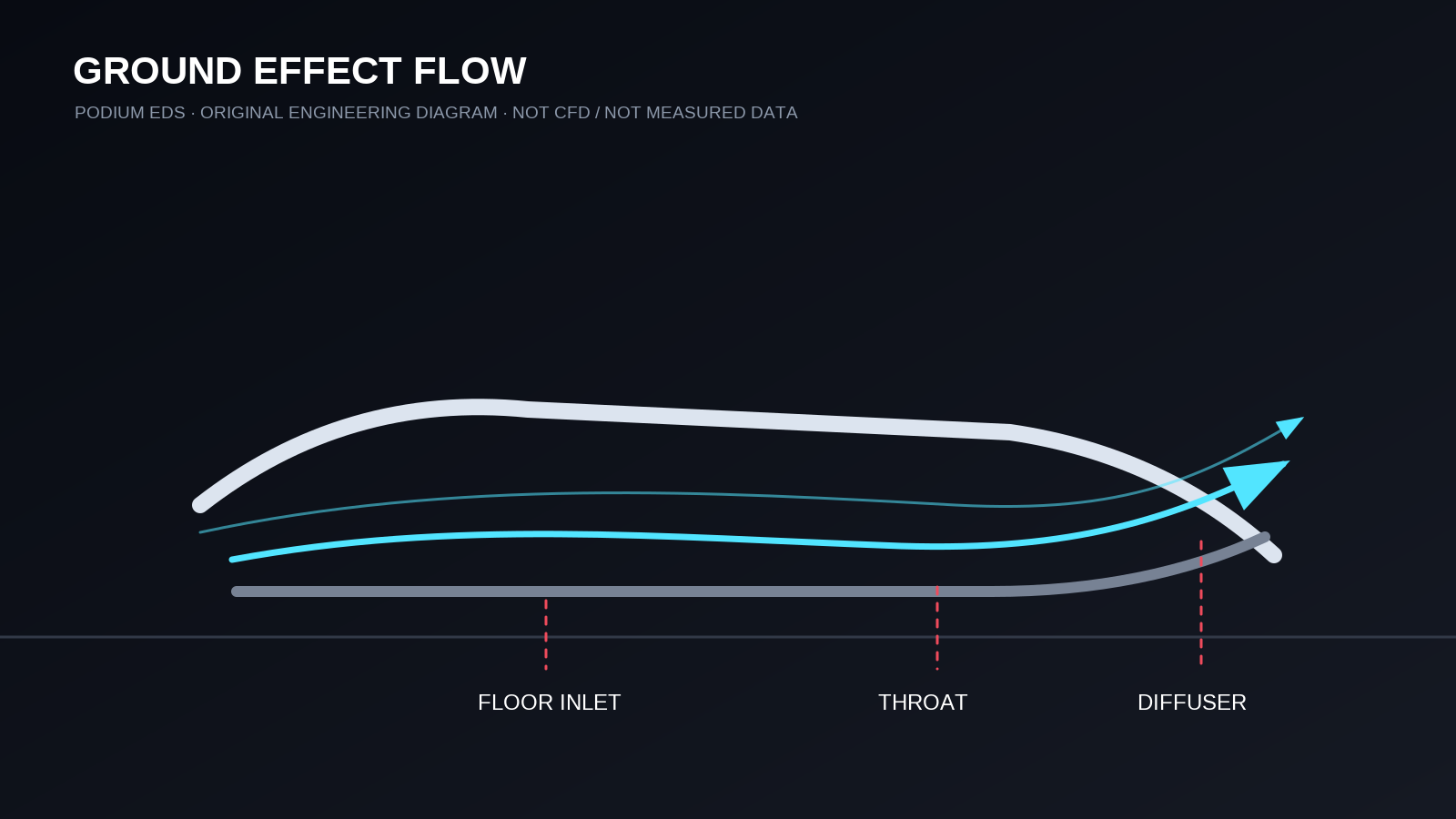
Trong sơ đồ khái niệm, các kênh sàn thu hẹp dần tới vùng họng rồi mở rộng về phía bộ khuếch tán. Hình minh họa mô tả ý đồ hình học, không phải ảnh CFD và không công bố hệ số lực ép. Giá trị kỹ thuật của mô hình nằm ở việc giúp người đọc nhận diện chuỗi chức năng: dẫn dòng vào, tăng tốc cục bộ, kiểm soát mép sàn và phục hồi áp suất ở cửa thoát.
From airflow to a pressure field
A car develops aerodynamic force when its surfaces change air momentum and the pressure distribution around the body. A ground-effect floor seeks to sustain a controlled low-pressure region below the car while pressure above remains higher. The integrated pressure and skin-friction forces over every surface produce the net load; Bernoulli's equation is useful intuition only under limited assumptions, not a complete solution for viscous, turbulent racing-car flow.
In the conceptual diagram, floor channels contract toward a throat and then expand into the diffuser. The illustration communicates geometric intent, not CFD output, and it makes no downforce-coefficient claim. Its engineering value is to expose the functional sequence: admit the flow, accelerate it locally, manage the floor edge and recover pressure at the exit.
Mép sàn, rò rỉ và độ cao gầm
Không khí áp suất cao bên ngoài luôn có xu hướng tràn vào vùng áp suất thấp dưới sàn. Vì xe hiện đại không dùng váy trượt kín mặt đường, mép sàn phải tạo cấu trúc dòng giúp hạn chế rò rỉ mà vẫn ổn định khi xe nghiêng, chồm hoặc đi qua gờ. Cấu trúc đó có thể suy yếu khi luồng khí gặp bánh trước, gió ngang hay dao động độ cao gầm; do đó hiệu suất đỉnh không phải tiêu chí duy nhất.
Trong một cấu hình sàn nhất định, hạ gầm có thể làm tương tác sàn–mặt đường mạnh hơn, nhưng xu hướng không phải lúc nào cũng đơn điệu: khe quá nhỏ có thể làm thay đổi lưu lượng và thúc đẩy tách dòng. Khi tải khí động tăng làm xe hạ thêm, hệ khí động và hệ treo tạo thành một vòng phản hồi. Đây là nguyên lý thiết kế, không phải kết quả đo trên mô hình khái niệm; một thiết kế hữu dụng cần vùng vận hành đủ rộng để thay đổi nhỏ về tư thế xe không gây biến đổi tải đột ngột mà người lái khó dự đoán.
Floor edges, leakage and ride height
Higher-pressure air outside the floor continually tries to leak into the low-pressure region underneath. Because a modern car does not use skirts sealing against the road, the floor edge must organize flow that limits leakage while remaining stable in roll, pitch and over bumps. That structure can weaken in front-wheel wake, crosswind or ride-height oscillation, so peak performance is not the only design criterion.
Within a given floor configuration, reducing ride height can strengthen floor–ground interaction, but the trend is not necessarily monotonic: an excessively small gap can alter mass flow and promote separation. As aerodynamic load compresses the car further, aerodynamics and suspension form a feedback loop. This is a design principle, not a measurement of the conceptual model; a useful design needs a broad operating window so a small attitude change does not produce an abrupt load change that the driver cannot anticipate.
Bộ khuếch tán và phục hồi áp suất
Bộ khuếch tán mở rộng tiết diện về phía sau, làm giảm vận tốc trung bình và giúp áp suất tăng dần trước khi dòng khí hòa vào vùng sau xe. Góc mở quá gắt tạo gradient áp suất bất lợi: lớp biên gần bề mặt mất động lượng, tách khỏi sàn và phá vỡ tải khí động. Vì vậy bộ khuếch tán là bài toán cân bằng giữa độ mở, chiều dài, hình dạng kênh và chất lượng dòng vào.
Cánh sau và khuếch tán cũng tương tác qua trường áp suất phía sau. Không nên xem từng bộ phận như một thiết bị độc lập rồi cộng lực lại. Trong quá trình thiết kế thật, kỹ sư sẽ khảo sát ma trận độ cao gầm, góc chồm, góc nghiêng và hướng gió bằng mô phỏng và thử nghiệm. Các sơ đồ khái niệm chỉ mang tính giáo dục; mọi định lượng vẫn cần một chương trình xác nhận riêng.
The diffuser and pressure recovery
The diffuser expands toward the rear, reducing mean velocity and allowing pressure to rise before the flow rejoins the wake. An overly aggressive expansion creates an adverse pressure gradient: the near-wall boundary layer loses momentum, separates from the floor and disrupts aerodynamic load. Diffuser design therefore balances expansion, length, channel shape and inlet-flow quality.
The rear wing and diffuser also interact through the pressure field behind the car. Components cannot be treated as isolated devices whose loads are simply added. A real development programme would sweep ride height, pitch, roll and yaw using simulation and testing. The conceptual diagrams are educational only; any quantitative performance claim would require a separate validation programme.
Cách đọc một thiết kế sàn
Khi quan sát sàn xe, hãy lần theo đường đi của không khí thay vì chỉ tìm một chi tiết nổi bật. Cửa vào có nhận dòng sạch không? Kênh có chuyển tiết diện êm không? Mép sàn đối phó với dòng nhiễu từ bánh như thế nào? Bộ khuếch tán có đủ chiều dài để phục hồi áp suất? Và quan trọng nhất, các câu trả lời thay đổi ra sao khi xe phanh, tăng tốc và vào cua.
Hotspot Sàn & khuếch tán trong Showroom cho phép đặt những câu hỏi đó trực tiếp trên Model B. Hãy xem mô hình như một bản đồ chức năng: nó trình bày mối quan hệ giữa các vùng hình học, nhưng không thay thế dữ liệu đo, lưới mô phỏng, điều kiện biên hoặc sai số cần có để đánh giá một thiết kế khí động thực tế.
How to read a floor design
When inspecting a floor, follow the air path instead of searching for one spectacular detail. Does the inlet receive clean flow? Do area changes remain gradual? How does the edge cope with wheel disturbance? Is the diffuser long enough to recover pressure? Most importantly, how do those answers change under braking, acceleration and cornering?
The Floor & Diffuser hotspot in the Showroom lets readers ask those questions directly on Model B. Treat the model as a functional map: it explains relationships between geometric regions, but it cannot replace measurements, simulation mesh, boundary conditions or uncertainty information required to assess a real aerodynamic design.
Nguồn kỹ thuật / Technical sources
Đã đối chiếu nguồn kỹ thuật; chưa phải thẩm định kỹ thuật hoặc pháp lý độc lập. / Technical sources checked; independent engineering and legal review remains required.
- NASA Glenn — Aerodynamic Forces
NASA Glenn educational page; current page observed · Hỗ trợ mô tả lực tổng từ phân bố áp suất và ma sát; Bernoulli chỉ là mô hình giản lược.
- NASA Glenn — Boundary Layer
NASA Glenn educational page; current page observed · Hỗ trợ điều kiện không trượt, lớp biên và cơ chế tách dòng do gradient áp suất bất lợi.
- NASA Glenn — Buice two-dimensional diffuser validation study
NASA Glenn validation archive; Buice diffuser case · Hỗ trợ bối cảnh dòng tách trong bộ khuếch tán và gradient áp suất bất lợi; không xác nhận hình học của sơ đồ khái niệm.